19.4 Sparse Autoencoders (SAE)
The supervised probes in the previous section tested predefined concepts. Probing is not exclusively supervised: CCS, for example, finds activation directions using logical consistency without labels [3]. SAEs instead learn a dictionary through reconstruction and sparsity; neither approach guarantees recovery of every concept.
Sparse Autoencoders (SAEs) learn sparse dictionaries from model activations. The GPT-4 and Claude 3 Sonnet studies below are dated research examples, not complete inventories of a model’s concepts or proof that every learned feature is human-interpretable.
1. The Superposition Hypothesis and Polysemanticity
If we want to understand what a neural network is “thinking,” the intuitive first step is to look at individual neurons. If a specific neuron fires every time the model processes the word “dog,” we might label it the “dog neuron.”
Some neurons respond to several input properties. The superposition hypothesis explains how a model with sparse active features can store more features than dimensions in overlapping directions. This is not a complete account of every neuron or concept; its fit to an actual representation requires testing.
The Superposition Hypothesis suggests that models pack multiple unrelated concepts into the same representation space by utilizing almost-orthogonal vectors. Because high-dimensional spaces contain exponentially more almost-orthogonal directions than strictly orthogonal ones, the model can represent vastly more features than it has dimensions.
The side effect of superposition is that individual neurons become polysemantic. A single neuron might fire when processing the word “Apple” (the fruit), “Apple” (the tech company), and “Apple” (the record label). Looking at the raw neuron activation tells us nothing about which concept is currently active.
Three directions in two dimensions
The second coordinate is identical for features 2 and 3. One coordinate cannot distinguish them. The full vectors differ; sparse activity is one condition that can help overlapping representations remain usable.
2. Dictionary Learning via Sparse Autoencoders
To untangle these polysemantic neurons, researchers treat the problem as Dictionary Learning. The goal is to find a set of sparse, overcomplete features (the dictionary) that linearly combine to form the model’s dense activation vectors.
A Sparse Autoencoder achieves this by projecting the -dimensional activation vector into a much larger -dimensional feature space (where , often 16x to 64x larger), and then reconstructing the original vector .
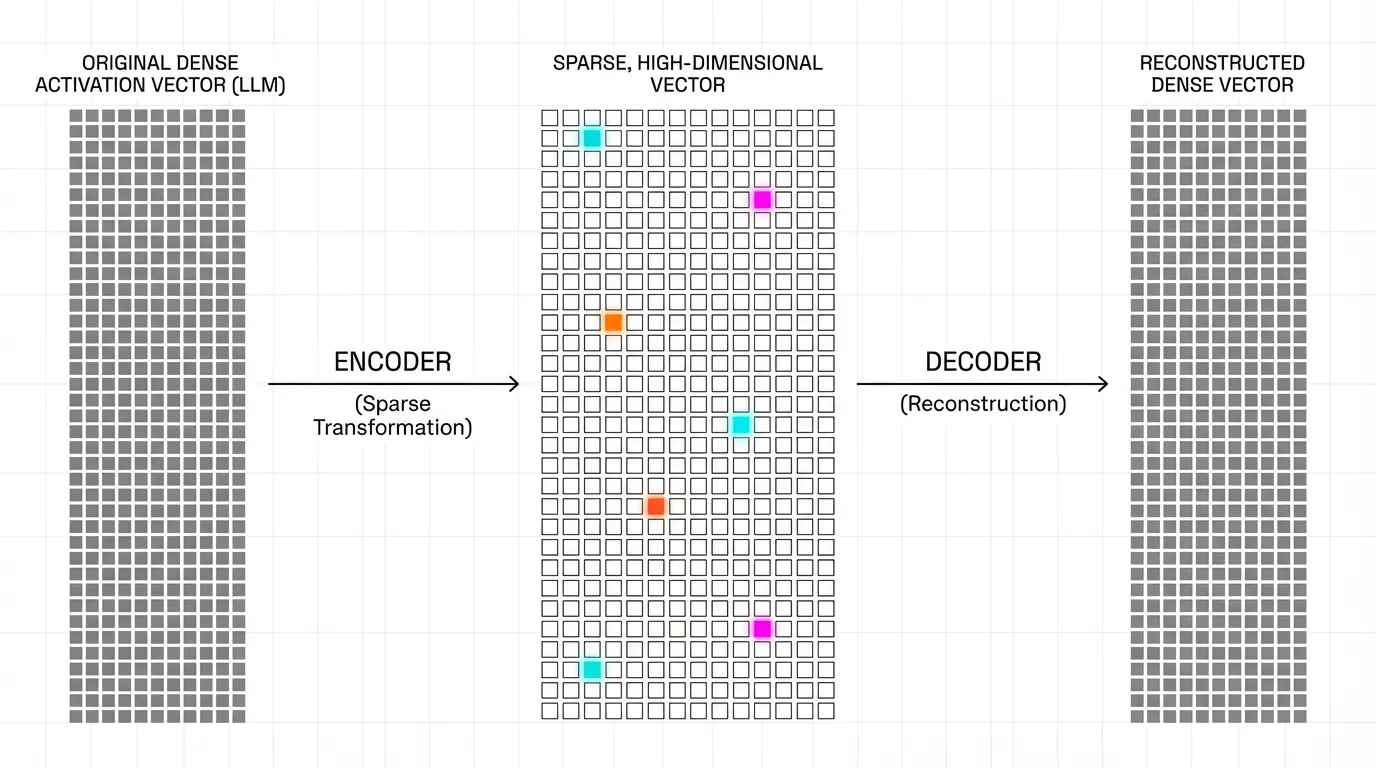 Source: AI-generated illustration
The forward pass of a standard SAE is defined as:
To encourage sparse feature decompositions, we force the network to use only a tiny fraction of the features for any given input. This is typically enforced by adding an regularization penalty to the reconstruction loss:
This objective needs a decoder-scale constraint, such as unit-norm feature columns. Otherwise shrinking features while enlarging the decoder preserves reconstruction and artificially reduces the L1 penalty. Here and are encoder and decoder weights, denotes biases, and weights the sparsity penalty.
Sparse dictionary learning can reveal interpretable directions, but reconstruction error, feature splitting, polysemantic latents, and dependence on training data remain.
3. The Dead Latent Problem
Training SAEs introduces severe engineering challenges. The most notorious is the Dead Latent (or Dead Neuron) problem.
Because the feature space is massive and the sparsity penalty () aggressively pushes activations to zero, many features in the SAE stop activating early in training. Once a feature stops activating, it receives zero gradient from the ReLU function, leaving it without a direct reconstruction gradient on those inputs. Measure inactivity over a declared sample window; recovery methods can alter this state.
SAE training pipelines employ several techniques to revive these dead latents:
- Ghost Gradients: Artificially routing gradients to dead neurons during the backward pass to give them a “nudge” toward useful directions.
- Re-initialization: Periodically identifying dead neurons and resetting their encoder weights to match the dense activation vectors () that currently have the highest reconstruction error.
4. Engineering Top-K SAEs
While the penalty enforces sparsity, it introduces a critical flaw: Shrinkage. The penalty constantly pulls all activations toward zero, meaning the SAE systematically underestimates the true magnitude of the features, degrading the reconstruction quality of .
In 2024, OpenAI researchers reported scaling a 16-million latent SAE on GPT-4 activations [2]. To solve the shrinkage problem, they completely removed the penalty and replaced it with an explicit Top-K activation function.
Instead of relying on a loss penalty to push values to zero, a Top-K SAE simply computes the dense activations, strictly selects the highest values, and forcefully zeros out the rest. This directly controls the sparsity without distorting the activation magnitudes.
Here is how a Top-K SAE is implemented in PyTorch:
Deliberately simplified example. It illustrates encoder/decoder shapes and top-K. Full training, decoder normalization, dead-latent recovery, activation sampling, and distributed execution are omitted. The large configuration below is a memory-planning illustration, not an executed experiment.
import torch
import torch.nn as nn
import torch.nn.functional as F

class TopKSAE(nn.Module):
    """
    Top-K Sparse Autoencoder (Gao et al., 2024).
    Replaces L1 regularization with an explicit Top-K activation function
    to solve the shrinkage problem and improve the sparsity-reconstruction frontier.
    """
    def __init__(self, d_model: int, d_sae: int, k: int):
        super().__init__()
        self.d_model = d_model
        self.d_sae = d_sae
        self.k = k

        # Initialize encoder and decoder weights
        # Decoder weights are typically unit-normalized in practice
        self.W_enc = nn.Parameter(torch.randn(d_model, d_sae) / (d_model ** 0.5))
        self.b_enc = nn.Parameter(torch.zeros(d_sae))

        self.W_dec = nn.Parameter(torch.randn(d_sae, d_model) / (d_sae ** 0.5))
        self.b_dec = nn.Parameter(torch.zeros(d_model))

        # Pre-encoder bias to center the activations
        self.b_pre = nn.Parameter(torch.zeros(d_model))

    def encode(self, x: torch.Tensor) -> torch.Tensor:
        # Center the input and project to high-dimensional feature space
        pre_acts = (x - self.b_pre) @ self.W_enc + self.b_enc
        acts = F.relu(pre_acts)

        # Explicit Top-K routing: keep only the top K activations, zero out the rest
        topk_vals, topk_indices = torch.topk(acts, self.k, dim=-1)

        # Reconstruct the sparse tensor
        sparse_acts = torch.zeros_like(acts)
        sparse_acts.scatter_(-1, topk_indices, topk_vals)

        return sparse_acts

    def decode(self, sparse_acts: torch.Tensor) -> torch.Tensor:
        # Project back to the original residual stream dimension
        return (sparse_acts @ self.W_dec) + self.b_dec + self.b_pre

    def forward(self, x: torch.Tensor) -> tuple[torch.Tensor, torch.Tensor]:
        sparse_acts = self.encode(x)
        x_reconstructed = self.decode(sparse_acts)
        return x_reconstructed, sparse_acts

# Example instantiation for a 4096-dim LLM residual stream
# Expanded to 131,072 features (32x expansion), keeping at most 32 nonzero
# sae = TopKSAE(d_model=4096, d_sae=131072, k=32)
5. Scaling Monosemanticity: The Golden Gate Claude
Anthropic applied SAEs to their production model, Claude 3 Sonnet, successfully extracting millions of highly abstract features [1]. Their findings fundamentally shifted how we view LLM representations.
Anthropic reported features responding across languages and across text and images, including a Golden Gate Bridge example. This supports shared representations on tested inputs, not complete concept separation or universal understanding [1].
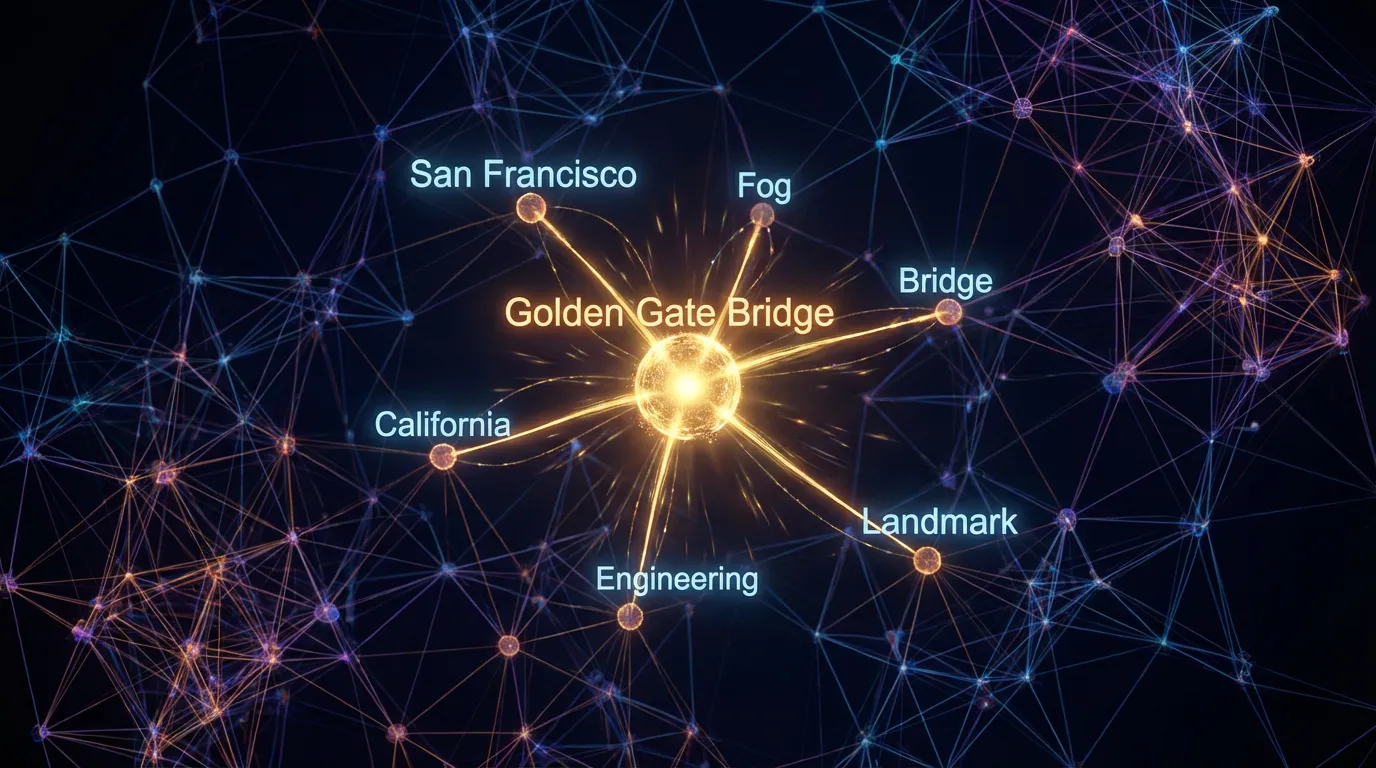 Source: AI-generated illustration
More importantly, SAEs allow for causal steering. In a famous experiment, Anthropic researchers artificially clamped the activation of the Golden Gate Bridge feature to a high value during the model’s forward pass. The result was “Golden Gate Claude”—a model that became obsessively fixated on the bridge. When asked “How do I spend a day in London?”, the model suggested taking a flight to San Francisco to see the Golden Gate Bridge.
Beyond tourist attractions, researchers identified features for sycophancy, bias, scam emails, and dangerous capabilities (like generating bioweapons). Steering or suppressing a feature can change behavior, but it does not guarantee selective removal of harmful behavior or preservation of general capabilities. Validate collateral effects, distribution shift, and adversarial bypass.
6. Auto-Interp and Codebook Saturation
When an SAE extracts 16 million features, human evaluation becomes impossible. To scale interpretability, researchers use Automated Interpretability (Auto-Interp).
In Auto-Interp, a separate, powerful LLM (like GPT-4) acts as a judge. The judge is fed dozens of text snippets that maximally activate a specific SAE feature and prompted to determine what they have in common. The judge generates a label (e.g., “Legal terminology related to breach of contract”). To verify the label’s accuracy, the judge is then asked to predict how strongly the feature will activate on unseen text snippets.
A lack of new labels does not establish dictionary completeness. Audit held-out inputs, low-activation and counterexamples, feature splitting/merging and the predictive quality of explanations.
From Features to Circuits: What a Label Does Not Prove
Research context as of 2026-10-13. Anthropic’s circuit-tracing study uses attribution graphs to investigate mechanisms in Claude 3.5 Haiku, while documenting incomplete coverage and limits on the prompts and behaviors its method can explain [5]. A feature label or a convincing generated explanation is not a causal circuit by itself.
Validate a proposed mechanism with controlled activation interventions, matched prompts, alternative hypotheses, reconstruction/behavioral fidelity, and held-out cases. Report which computations the surrogate preserves and which it misses. Causal steering establishes an effect of an intervention in the tested setting; it does not establish that a feature is the sole cause of a behavior or that suppressing it is a robust safety policy.
7. Engineering decisions for SAE use
Use SAEs when the question concerns candidate features, repeated behavior or activation interventions. These are hypotheses to test, not guaranteed safety controls. For unsupported RAG answers, claim verification may be more direct; for coding failures, execution tests and agent traces may be cheaper. Small mechanism studies can begin with probes, patching or a logit lens.
Record the base checkpoint, tokenizer, activation layer/site, data manifest and quarantined evaluation splits. Choose dictionary size, sparsity target, learning rate and decoder normalization before training. Budget encoder/decoder parameters, gradients, optimizer state, activation buffers and sampling overhead separately; the dense example below does not represent a memory-efficient training system.
Monitor reconstruction error and behavioral fidelity, nonfinite values, gradient norms, throughput, dead-latent rate over a declared window, sparsity by domain and held-out interpretability. Abort on nonfinite losses or unacceptable behavioral degradation. Save SAE/optimizer/scheduler/RNG states, data cursor and base-model/config hashes; evaluate interventions against matched controls and held-out tasks before release, retaining a last-known-good artifact.
A feature label alone is not a mechanism. Circuit tracing asks which features affect other features and output logits, while its methods paper documents the approximation’s limits [4].
8. Summary and Open Questions
SAEs provide a useful but incomplete view of activations. The GPT-4 study used Top-K SAEs, while the Claude 3 Sonnet study used an L1-based SAE. These are distinct recipes. Feature interventions can affect observed behavior without guaranteeing selective safety control or preservation of general capabilities.
However, extracting features is only half the battle. If an LLM is a machine that “thinks,” features are merely the nouns and verbs of its thoughts. The next frontier in mechanistic interpretability is understanding how these features wire together to perform complex logic. How does the “If-Then” feature interact with the “Python Code” feature to generate a working script?
To answer this, we must map the Circuits of the LLM.
Quizzes
Quiz 1: What does superposition explain, and what does it not establish?
Sparse features can share overlapping directions, allowing more features than dimensions. This does not identify every neuron’s function or recover every concept.
Quiz 2: Does a larger L1 weight guarantee better interpretability?
No. It changes the sparsity–reconstruction tradeoff and can cause shrinkage, but interpretability and behavioral fidelity require separate tests. Decoder-scale constraints are also necessary.
Quiz 3: How does the Top-K SAE architecture solve the “shrinkage” problem inherent in standard -regularized SAEs?
A Top-K SAE completely removes the penalty. Instead, it computes the dense activations, explicitly selects only the Top highest values, and forcefully zeros out the rest. This bounds the number of nonzero activations by ; selected ReLU values can themselves be zero. It controls sparsity without applying a continuous mathematical penalty that shrinks the magnitude of the active features.
Quiz 4: What does a cross-modal SAE activation establish?
It supports a shared representation for the tested inputs. It does not prove universal concept understanding, complete feature discovery, or causal necessity.
Quiz 5: Why should a feature intervention be compared with matched controls?
Changing one activation can have broad downstream effects. Matched prompts, alternative features, and held-out cases help separate a specific mechanism from generic disruption.
References
- Templeton, A., et al. (2024). Scaling Monosemanticity: Extracting Interpretable Features from Claude 3 Sonnet. Transformer Circuits Thread. Link.
- Gao, L., et al. (2024). Scaling and evaluating sparse autoencoders. arXiv:2406.04093.
- Burns, C., et al. (2023). Discovering Latent Knowledge in Language Models Without Supervision. Paper.
- Ameisen, E., et al. (2025). Circuit Tracing: Revealing Computational Graphs in Language Models. Source.
- Anthropic. (2025). On the Biology of a Large Language Model. Source.