20.4 Neural Networks as Programs: The Future of Execution
The evolution of artificial intelligence has largely been a journey from static, rule-based systems to dynamic, data-driven models. However, the next frontier in Foundation Models is blurring the line between data and code. We are moving towards a paradigm where neural networks are not just function approximators, but program generators and executors.
This chapter explores the concept of “Neural Networks as Programs”—a useful framing for systems in which models generate, manipulate, or partially simulate structured procedures to solve reasoning tasks.
From Static Weights to Dynamic Execution
Traditionally, a neural network is viewed as a fixed computation graph with learned weights. It takes an input, passes it through layers of matrix multiplications and non-linearities, and produces an output. While powerful, this approach struggles with tasks that require explicit algorithmic logic, long-term state management, or exact precision (e.g., executing a multi-step mathematical algorithm).
The concept of Neural Networks as Programs shifts this perspective in two major ways:
- Neural Networks as Program Generators: The model generates explicit code (e.g., Python, SQL) or domain-specific languages (DSLs) to solve a problem, which is then executed by an external interpreter.
- Neural Networks as Program Executors: The model itself learns to simulate the execution of a program, maintaining state and memory dynamically, similar to a traditional CPU or virtual machine.
The Evolution: NTMs to Modern LLMs
The idea of neural networks with program-like capabilities is not new. Early research laid the groundwork for modern approaches:
- Neural Turing Machines (NTMs): Introduced by Graves et al. (2014) [1], NTMs coupled a neural network controller with an external memory bank. This allowed the network to learn basic algorithms like copying, sorting, and associative recall, effectively acting as a differentiable computer.
- Differentiable Neural Computers (DNCs): An evolution of NTMs [2], offering more complex memory addressing mechanisms and better performance on structured tasks like graph traversal.
While these models proved that neural networks could learn algorithmic logic, they were difficult to train and scale. The breakthrough came with the scale of Large Language Models (LLMs) and their emergent ability to generate high-quality code.
LLMs as Program Generators: Execution-Guided Synthesis
One of the most practical manifestations of this concept today is Execution-Guided Synthesis (often seen in code execution environments or data-analysis assistants). Instead of attempting to solve a complex mathematical or logical problem entirely inside its weights, the LLM writes a Python program to solve it.
This creates a powerful feedback loop:
- Generate: The model writes a program based on the user’s prompt.
- Execute: An external environment executes the program and returns the results or error logs.
- Refine: If the execution fails or produces an error, the model reads the error logs and generates a corrected version of the program.
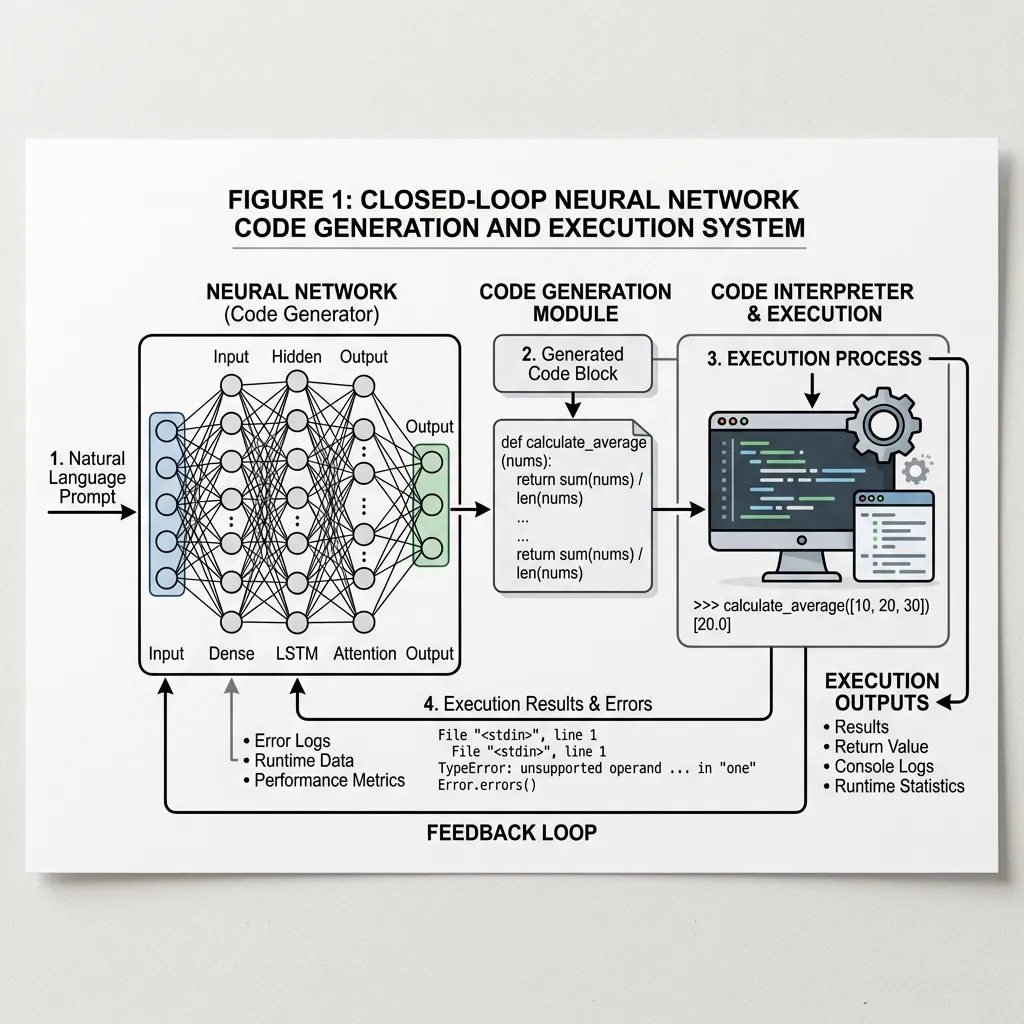 Source: AI-generated illustration
External execution makes arithmetic and state transitions testable, but a wrong program deterministically produces a wrong result. Validate specifications, edge cases and independent tests; enforce sandboxing, least privilege and time/cost limits. Passing tests does not prove correctness on untested inputs.
A coding-agent workflow
Read the relevant files, tests, documentation and issue; plan the change; produce a patch; run unit, type and integration checks; inspect failures; and iterate within a budget. The model acts as a controller that proposes programs and interprets execution results. Search tools, test runners, type checkers and sandboxes provide distinct capabilities; the model does not replace a CPU.
Simulating Execution: The Neural Interpreter
Beyond generating code for external execution, another research direction is training models to simulate execution internally. This is especially relevant when an external interpreter is unavailable, too slow, or too expensive to call repeatedly.
Consider a model trained to predict the output of a Python script. To do this accurately, the model must maintain a mental model of the variable states and the flow of control.
PyTorch Example: A Simple Neural State Machine
While full program synthesis is beyond a simple example, we can demonstrate how a neural network can be trained to act as a simple state machine or program executor. Here, we implement a simple Recurrent Neural Network (RNN) that learns to simulate a counter that increments or decrements based on input instructions, demonstrating state retention and execution logic.
Educational toy training. This repeatedly fits 32 synthetic sequences of length 10. Lower training error does not establish algorithm learning or generalization to longer sequences. Distributed training, checkpointing and an evaluation pipeline are omitted.
import torch
import torch.nn as nn
import torch.optim as optim

class NeuralCounter(nn.Module):
    def __init__(self, input_size, hidden_size, output_size):
        super(NeuralCounter, self).__init__()
        self.hidden_size = hidden_size
        # RNN layer to maintain state
        self.rnn = nn.RNN(input_size, hidden_size, batch_first=True)
        # Linear layer to map hidden state to output value
        self.fc = nn.Linear(hidden_size, output_size)

    def forward(self, x, initial_state=None):
        # x shape: (batch_size, sequence_length, input_size)
        if initial_state is None:
            initial_state = x.new_zeros(1, x.size(0), self.hidden_size)

        out, hidden = self.rnn(x, initial_state)
        # Map output of all time steps
        out = self.fc(out)
        return out, hidden

# Hyperparameters
input_size = 2  # [Increment, Decrement] one-hot encoded
hidden_size = 16
output_size = 1 # The current count
seq_length = 10
batch_size = 32

# Model instantiation
model = NeuralCounter(input_size, hidden_size, output_size)
criterion = nn.MSELoss()
optimizer = optim.Adam(model.parameters(), lr=0.01)

# Dummy Training Data Generation
# Input: Sequence of increments (1,0) and decrements (0,1)
# Target: Cumulative sum
inputs = torch.randint(0, 2, (batch_size, seq_length, 1))
# Convert to one-hot: shape (batch_size, seq_length, 2)
inputs_one_hot = torch.zeros(batch_size, seq_length, 2)
inputs_one_hot.scatter_(2, inputs, 1.0)

# Calculate targets (cumulative sum of increments - decrements)
targets = torch.zeros(batch_size, seq_length, 1)
for i in range(batch_size):
    current_count = 0.0
    for t in range(seq_length):
        if inputs[i, t, 0] == 0: # Increment
            current_count += 1.0
        else: # Decrement
            current_count -= 1.0
        targets[i, t, 0] = current_count

# Training Loop
for epoch in range(100):
    optimizer.zero_grad()
    outputs, _ = model(inputs_one_hot)
    loss = criterion(outputs, targets)
    loss.backward()
    optimizer.step()

    if (epoch + 1) % 20 == 0:
        print(f'Epoch [{epoch+1}/100], Loss: {loss.item():.4f}')

print("Training ended. Evaluate independent sequences and longer lengths.")
In this example, the RNN hidden state acts as the “memory” or “register” holding the current count, and the network learns to update this state based on the input instructions.
Experiment and release boundaries
Inputs are increment/decrement instructions; the objective is MSE against the cumulative count at each position. The example uses CPU FP32, hidden width 16, Adam at 0.01, a fixed batch of 32 and 100 updates. Evaluate MSE and exact count agreement on unseen sequences from a separate seed and on longer lengths; abort on nonfinite loss or divergence. Deduplicate before assigning train/evaluation sequences and record generation rules and seeds.
For recovery, save model/optimizer/RNG states, step and data-generation configuration. Budget gradients, optimizer state and sequence activations in addition to checkpoint weights. A deployed execution tool needs correctness, permission, latency and cost regression gates plus a last-known-good version.
Neuro-symbolic systems combine learning with explicit procedures. Treat generated algorithms or self-modifications as hypotheses and candidate patches requiring independent verification and controlled release.
Quizzes
Quiz 1: Does an external interpreter guarantee the generated program is correct?
No. Incorrect specifications or buggy code yield wrong results even when executed exactly. Use independent tests, edge cases, sandboxing, permissions and resource limits.
Quiz 2: How does NTM external memory differ from an RNN state?
It separates the controller from addressable memory, enabling location-selective reads and writes. This can support longer-sequence behavior but does not guarantee extrapolation; test held-out lengths.
Quiz 3: In the context of Neuro-Symbolic AI, what does “Symbolic” refer to?
It refers to traditional rule-based AI, logic, and discrete representations (like code or mathematical formulas). Combining this with “Neural” networks allows systems to benefit from both intuitive pattern recognition and rigorous logical deduction.
Quiz 4: Neural Turing Machines (NTMs) use a hybrid addressing mechanism for memory access. Formulate the mathematical equations for Content-based addressing and the subsequent interpolation gating step in location-based addressing.
NTMs use a multi-step addressing mechanism to generate the memory weight vector .
1. Content-based addressing: The controller outputs a key vector and a positive scalar key strength . The weight for location is determined by cosine similarity with the memory matrix :
where is the cosine similarity.
2. Interpolation Gate: To blend the content-based address with the addressing vector from the previous time step , NTM uses a scalar interpolation gate output by the controller:
This enables the network to either focus on similar content or iterate sequentially based on past focus.
References
- Graves, A., Wayne, G., & Danihelka, Ivo. (2014). Neural Turing Machines. arXiv:1410.5401.
- Graves, A., et al. (2016). Hybrid computing using a neural network with dynamic external memory. Nature, 538(7626), 471-476.