12.3 Continuous Batching
While PagedAttention (discussed in the previous section) brilliantly solved the spatial problem of LLM inference—eliminating memory fragmentation and maximizing KV cache utilization—it did not address the temporal problem. Memory is only half the equation; how we schedule compute on the GPU determines the ultimate throughput of the system.
In traditional deep learning (e.g., classifying images with a ResNet), batching is straightforward: you group images, run a single forward pass, and get predictions simultaneously. All items in the batch take the exact same amount of time to process.
Autoregressive LLM inference, however, is highly dynamic. A user’s prompt might be 10 tokens or 10,000 tokens. The generated response might be a single word (“Yes.”) or a massive essay. This dynamic sequence length breaks traditional static batching paradigms, forcing modern inference engines to adopt OS-level scheduling concepts. The result is Continuous Batching (also known as iteration-level or in-flight batching), a technique that fundamentally altered the economics of LLM serving.
1. The Flaw of Static Batching: The Convoy Effect
Prior to 2022, inference frameworks like HuggingFace Transformers utilized Static Batching. In this paradigm, a batch of requests is formed, and the GPU processes them until every single request in the batch has emitted an <EOS> (End of Sequence) token or reached its maximum length.
Consider a batch of four requests:
- Request A: Generates 10 tokens.
- Request B: Generates 25 tokens.
- Request C: Generates 15 tokens.
- Request D: Generates 100 tokens.
In static batching, Requests A, B, and C finish very quickly. However, they cannot leave the batch, and their GPU memory cannot be freed, because the batch as a whole is waiting for Request D to finish generating its 100th token.
This phenomenon is known as the Convoy Effect or the early termination problem. The GPU ends up doing dummy computations (or masking) for A, B, and C for 90 iterations just to accommodate D. As a result, GPU compute utilization plummets, and new requests waiting in the queue experience severe head-of-line blocking.
2. The Paradigm Shift: Iteration-Level Scheduling
To solve the Convoy Effect, researchers introduced Iteration-Level Scheduling in the seminal 2022 paper Orca: A Distributed Serving System for Transformer-Based Generative Models [1].
Instead of scheduling at the granularity of a request, the engine schedules at the granularity of an iteration (the generation of a single token). After every forward pass—which generates exactly one token for all active requests—the scheduler pauses and evaluates the batch:
- Did any request emit an
<EOS>token? If yes, immediately evict it from the batch and free its logical KV cache blocks. - Is there space in the batch (and sufficient VRAM)? If yes, immediately pull a new request from the waiting queue and insert it into the active batch.
By continuously swapping requests in and out on a token-by-token basis, the GPU never waits for a long sequence to finish. The batch size remains artificially “full” at all times, maximizing throughput.
Interactive: Static vs. Continuous Batching
Use the interactive visualizer below to observe the difference. In Static Batching, notice how empty slots (wasted compute) accumulate while waiting for the longest request to finish. In Continuous Batching, notice how new requests seamlessly slide into the batch the moment a slot opens up.
Static Batching
Waits for the longest request to finish.
Continuous Batching
Swaps requests at iteration level.
Waiting Queue
3. The Compute-Memory Dichotomy: Prefill vs. Decode
While continuous batching sounds conceptually simple, implementing it efficiently on GPU hardware is exceptionally difficult. This difficulty arises because LLM inference consists of two entirely different computational phases with conflicting hardware profiles:
- The Prefill Phase (Prompt Processing): When a new request enters the batch, the model must process its entire input prompt simultaneously to compute the initial KV cache. Mathematically, this is a massive Matrix-Matrix Multiplication (GEMM). It is highly parallelizable, heavily utilizes the GPU’s Tensor Cores, and is Compute-Bound.
- The Decode Phase (Token Generation): Once the prompt is processed, the model generates one token at a time. For each token, the model multiplies the new token’s query vector against the entire historical KV cache. Mathematically, this is a Matrix-Vector Multiplication (GEMV). It cannot fully utilize Tensor Cores and is severely Memory-Bandwidth-Bound.
When using continuous batching, the scheduler inevitably mixes these two phases. A newly inserted request must undergo its Prefill phase, while the existing requests in the batch are undergoing their Decode phase.
4. Modern SOTA: Chunked Prefill
Mixing prefill and decode creates a massive scheduling collision. Suppose you have 30 requests in the decode phase, generating tokens smoothly every 20 milliseconds. Suddenly, a new request with a massive 50,000-token prompt enters the batch.
Processing a 50k-token prefill might take the GPU 800 milliseconds of pure compute time. Because the GPU is occupied with this massive GEMM operation, the 30 decode requests are “stalled.” They will not generate a token for 800ms. To the end users, the text generation will suddenly stutter and freeze. This violates strict Service Level Objectives (SLOs), specifically the Time-Between-Tokens (TBT) metric.
To solve this, modern inference engines (such as vLLM, SGLang, and TensorRT-LLM) implement Chunked Prefill (first popularized by systems like SARATHI [2]).
Instead of processing a massive prompt all at once, the scheduler splits the prompt into manageable chunks (e.g., 1,024 or 2,048 tokens). During each iteration, the scheduler “piggybacks” exactly one prefill chunk alongside the ongoing decode requests.
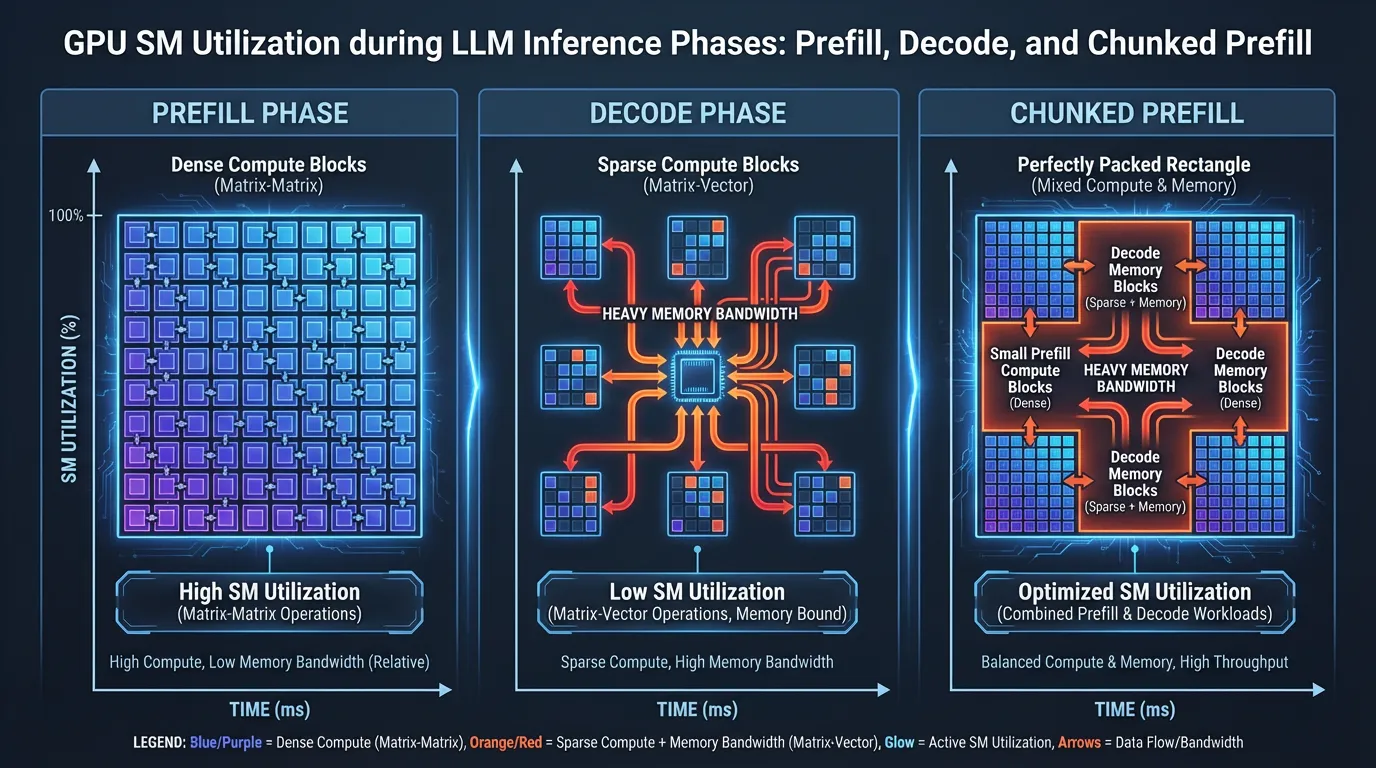
Why this is brilliant: Decode phases are memory-bound, meaning the compute units (Tensor Cores) are sitting idle waiting for data from HBM. Chunked prefill takes small chunks of compute-heavy work and schedules them onto those idle Tensor Cores. It perfectly balances the arithmetic intensity of the workload, achieving near 100% GPU utilization without stalling the generation of ongoing decodes.
5. Engineering the Scheduler (PyTorch Simulation)
To understand the mechanics of a modern iteration-level scheduler, we can simulate its core event loop in Python. The code below demonstrates how requests are transitioned between states (waiting, prefill, decode, finished) at every token generation step.
import torch
from typing import List

class InferenceRequest:
    def __init__(self, req_id: int, prompt_length: int, max_new_tokens: int):
        self.req_id = req_id
        self.prompt_length = prompt_length
        self.max_new_tokens = max_new_tokens
        self.generated_tokens = 0
        self.status = "waiting" # States: waiting, prefill, decode, finished

class ContinuousBatchingScheduler:
    def __init__(self, max_batch_size: int):
        self.waiting_queue: List[InferenceRequest] = []
        self.running_batch: List[InferenceRequest] = []
        self.max_batch_size = max_batch_size

    def add_request(self, request: InferenceRequest):
        self.waiting_queue.append(request)

    def _evict_finished_requests(self):
        """Removes requests that have completed generation."""
        active = []
        for req in self.running_batch:
            # In reality, we also check for the <EOS> token ID here
            if req.generated_tokens >= req.max_new_tokens:
                req.status = "finished"
                print(f"Request {req.req_id} finished.")
            else:
                active.append(req)
        self.running_batch = active

    def _pull_new_requests(self):
        """Pulls requests from the queue if there is batch capacity."""
        available_slots = self.max_batch_size - len(self.running_batch)

        while available_slots > 0 and self.waiting_queue:
            new_req = self.waiting_queue.pop(0)
            new_req.status = "prefill"
            self.running_batch.append(new_req)
            available_slots -= 1

    def step(self, mock_model_forward):
        """Executes a single iteration (one token generation step)."""
        # 1. Clean up finished requests from the previous step
        self._evict_finished_requests()

        # 2. Fill empty slots with new requests
        self._pull_new_requests()

        if not self.running_batch:
            return # Engine is idle

        # 3. Separate requests by phase
        prefill_reqs = [r for r in self.running_batch if r.status == "prefill"]
        decode_reqs = [r for r in self.running_batch if r.status == "decode"]

        # 4. Execute Forward Pass
        # A real engine uses Custom CUDA kernels to fuse chunked prefills
        # with decodes into a single pass.
        mock_model_forward(prefill_reqs, decode_reqs)

        # 5. Update request states
        for req in self.running_batch:
            if req.status == "prefill":
                # After one iteration, prompt is processed, transition to decode
                req.status = "decode"
            elif req.status == "decode":
                req.generated_tokens += 1

# --- Simulation ---
def mock_forward(prefill, decode):
    # Simulates GPU execution time
    pass

scheduler = ContinuousBatchingScheduler(max_batch_size=4)
for i in range(6):
    # Mix of short and long generation requests
    scheduler.add_request(InferenceRequest(i, prompt_length=100, max_new_tokens=(i+1)*5))

iteration = 0
while scheduler.waiting_queue or scheduler.running_batch:
    print(f"Iteration {iteration} | Active Batch Size: {len(scheduler.running_batch)}")
    scheduler.step(mock_forward)
    iteration += 1
6. Summary and Open Questions
Continuous Batching transformed LLM inference schedulers from simple First-In-First-Out (FIFO) queues into complex, OS-like task managers. By operating at the iteration level, inference engines can sustain high GPU utilization regardless of request length variance. Furthermore, advanced techniques like Chunked Prefill allow engineers to balance the compute-heavy prefill phase with the memory-bound decode phase, ensuring high throughput without sacrificing latency (TBT).
However, even with perfect scheduling and memory management, we are fundamentally limited by the memory bandwidth of the GPU during the decode phase. Generating one token at a time requires loading the entire model’s weights from HBM to SRAM for every single step. Is there a way to break this autoregressive bottleneck and generate multiple tokens per forward pass? We will explore this in the next section: Speculative Decoding.
Quizzes
Quiz 1: Why does static batching lead to a severe drop in GPU utilization during LLM inference?
Because of the Convoy Effect (or early termination problem). If requests in a batch have varying generation lengths, the shorter requests finish early but cannot free their memory or exit the batch until the longest request finishes. The GPU wastes cycles waiting, rather than processing new requests.
Quiz 2: What is the primary difference in hardware utilization between the Prefill phase and the Decode phase?
The Prefill phase processes the entire prompt simultaneously via Matrix-Matrix Multiplication (GEMM), making it highly Compute-Bound. The Decode phase generates one token at a time via Matrix-Vector Multiplication (GEMV), making it severely Memory-Bandwidth-Bound because it must constantly read the KV cache and model weights.
Quiz 3: How does Chunked Prefill solve the latency jitter (stuttering) problem in continuous batching?
If a massive prefill request enters the batch, it monopolizes the GPU’s compute resources, stalling the token generation of ongoing decode requests and causing TBT (Time-Between-Tokens) spikes. Chunked prefill splits the large prompt into smaller blocks and piggybacks them onto decode iterations, balancing compute and memory operations without stalling the decodes.
Quiz 4: In an iteration-level scheduler, at what exact point can a new request from the waiting queue enter the active GPU batch?
At the boundary of any token generation step (iteration). Immediately after a forward pass completes, the scheduler evaluates the batch, evicts any requests that generated an EOS token, and pulls in new requests before the next forward pass begins.
Quiz 5: Formulate the mathematical state transition of the scheduler queue for Static Batching versus Continuous (Dynamic) Batching. Let be the set of active requests at iteration , be the waiting queue, and be the iteration at which request emits
In Static Batching, the state transition is block-based: if such that . New requests can only be pulled when the batch is completely empty: only if . In Continuous Batching, the state transition happens at the iteration level: . This ensures that is maximized to at every iteration , preventing convoy effects.<EOS>.
References
- Yu, G.-I., Jeong, J. S., Kim, G.-W., Kim, S., & Chun, B.-G. (2022). “Orca: A Distributed Serving System for Transformer-Based Generative Models”. 16th USENIX Symposium on Operating Systems Design and Implementation (OSDI 22). arXiv:2203.10842
- Agrawal, A., Panwar, A., Mohan, J., Kwatra, N., Gulavani, B. S., & Ramjee, R. (2023). SARATHI: Efficient LLM Inference by Piggybacking Decodes with Chunked Prefills. arXiv preprint arXiv:2308.16369. arXiv:2308.16369