5.3 Expert Parallelism
In the previous section, we established the mathematical elegance of routing algorithms. However, a perfect routing algorithm is useless if the hardware cannot physically store or compute the model.
Consider a frontier model with 256 experts per layer, where each expert contains 2 billion parameters. Storing just one Mixture of Experts (MoE) layer in FP16 requires over 1 Terabyte of VRAM. A single NVIDIA B200 GPU possesses 192GB of memory. It is physically impossible to fit this model on a single device, or even a single 8-GPU node.
While traditional Data Parallelism (DP) and Tensor Parallelism (TP) are excellent for dense models, they are highly inefficient for MoE architectures. If we use TP to slice 256 experts across 8 GPUs, every GPU must participate in computing every expert, entirely defeating the compute-saving purpose of sparse activation.
The solution is Expert Parallelism (EP). Instead of slicing the matrices of an expert, we shard the experts themselves across different GPUs. GPU 0 holds Experts 0-31, GPU 1 holds Experts 32-63, and so on. This isolates memory and compute, but introduces a massive distributed systems challenge: The All-to-All Network Bottleneck.
1. The Anatomy of Expert Parallelism
In a standard Transformer block within an MoE model, the self-attention mechanism is typically dense. Therefore, attention layers are processed using standard Data Parallelism or Tensor Parallelism. Every GPU holds a replica (or a TP shard) of the attention weights and processes its local batch of tokens.
The paradigm shifts when the tokens reach the MoE feed-forward layer. A token residing on GPU 0 might be routed to Expert 42, which physically resides on GPU 1.
To resolve this, Expert Parallelism requires a highly synchronized, two-phase network operation:
- The Dispatch Phase (All-to-All): Every GPU looks at its local tokens, groups them by their target expert, and transmits them across the network to the GPU that owns that expert.
- The Compute Phase: Each GPU receives a massive, unpredictable influx of tokens from all other GPUs. It processes these tokens through its locally stored experts.
- The Combine Phase (All-to-All): The computed token representations are transmitted back across the network to the original GPUs that generated them, allowing the next dense attention layer to proceed.
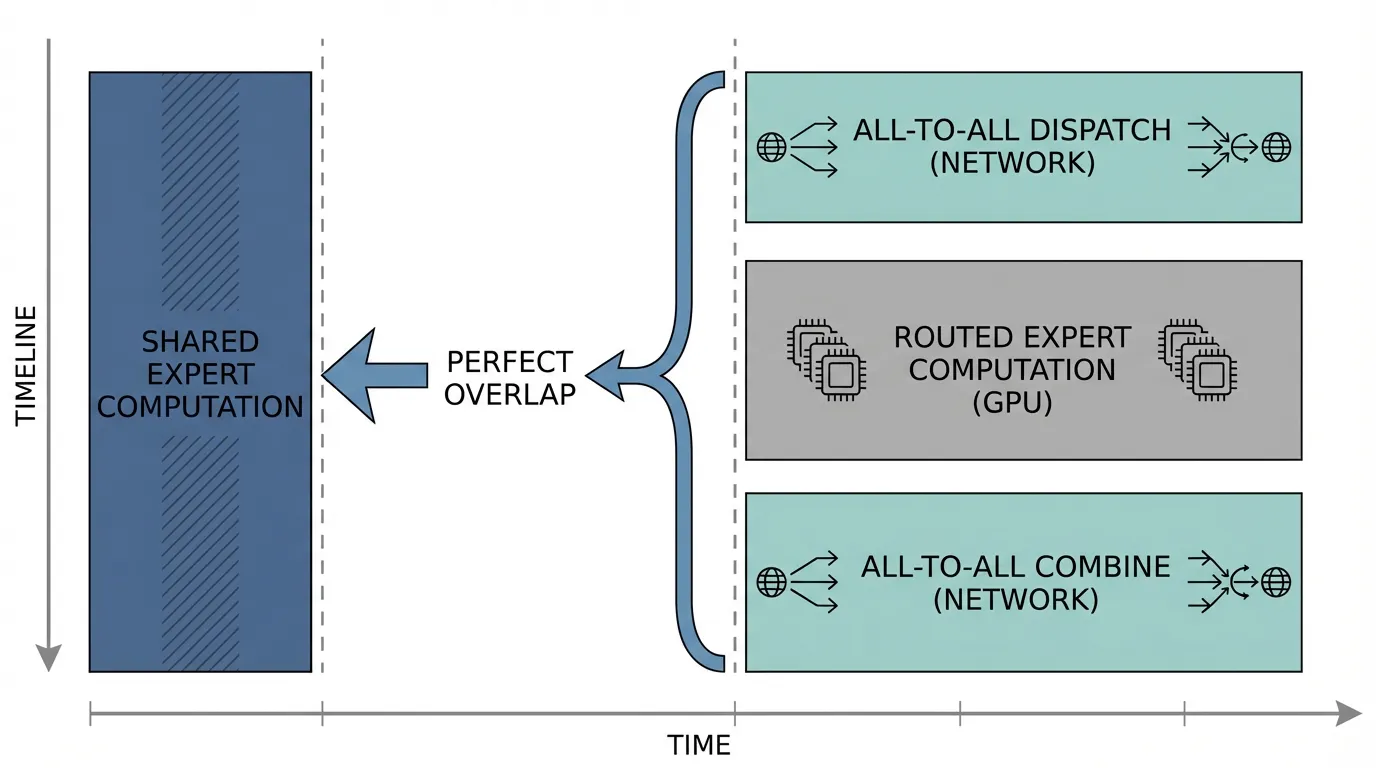 Source: Generated by Gemini
2. Engineering the Dispatcher
The core operation powering Expert Parallelism is the All-to-All collective communication primitive. Unlike an All-Reduce (where tensors are summed) or an All-Gather (where tensors are concatenated), an All-to-All is effectively a distributed matrix transpose. Every rank sends a different slice of data to every other rank.
Because routing is dynamic, GPU 0 does not know in advance how many tokens it will receive from GPU 1. Therefore, before we can send the actual high-dimensional token tensors, we must perform a metadata exchange to allocate the correct memory buffers.
Here is a highly realistic PyTorch implementation of the EP Dispatch phase, utilizing torch.distributed.all_to_all_single, mirroring the logic found in production frameworks like Megatron-LM and DeepSpeed [1].
import torch
import torch.distributed as dist

class ExpertParallelDispatcher:
    def __init__(self, ep_group, num_total_experts):
        """
        ep_group: The torch.distributed process group for Expert Parallelism.
        num_total_experts: Total number of experts across all GPUs.
        """
        self.ep_group = ep_group
        self.world_size = dist.get_world_size(ep_group)
        self.rank = dist.get_rank(ep_group)

        # Assume experts are distributed evenly across the EP group
        assert num_total_experts % self.world_size == 0
        self.local_experts = num_total_experts // self.world_size

    def dispatch(self, hidden_states, expert_indices):
        """
        hidden_states: [num_local_tokens, d_model]
        expert_indices: [num_local_tokens] (Global expert IDs chosen by the router)
        """
        device = hidden_states.device

        # 1. Determine which GPU (rank) owns which expert
        target_ranks = expert_indices // self.local_experts

        # 2. Sort tokens by their target rank to prepare for contiguous network transmission
        sort_idx = torch.argsort(target_ranks)
        sorted_states = hidden_states[sort_idx]
        sorted_target_ranks = target_ranks[sort_idx]

        # 3. Count how many tokens this GPU needs to send to each other GPU
        send_counts = torch.bincount(sorted_target_ranks, minlength=self.world_size)
        send_counts_list = send_counts.cpu().tolist()

        # 4. METADATA EXCHANGE: Inform other GPUs how many tokens to expect from us
        # We must know recv_counts to allocate the incoming memory buffer.
        recv_counts = torch.empty_like(send_counts)
        dist.all_to_all_single(recv_counts, send_counts, group=self.ep_group)
        recv_counts_list = recv_counts.cpu().tolist()

        # 5. Allocate the receive buffer for incoming tokens
        total_recv = sum(recv_counts_list)
        recv_buffer = torch.empty(
            (total_recv, hidden_states.size(1)),
            dtype=hidden_states.dtype,
            device=device
        )

        # 6. THE DISPATCH: Perform the actual All-to-All token transfer via NVLink/InfiniBand
        dist.all_to_all_single(
            recv_buffer,
            sorted_states,
            output_split_sizes=recv_counts_list,
            input_split_sizes=send_counts_list,
            group=self.ep_group
        )

        # recv_buffer now contains tokens from all over the cluster destined for our local experts.
        return recv_buffer, recv_counts_list, sort_idx, send_counts_list
3. Advanced Optimizations: Overlapping and GroupGEMM
While the All-to-All logic above is functionally correct, running it naively results in catastrophic hardware underutilization. When dist.all_to_all_single is called, the GPU’s Compute Streaming Multiprocessors (SMs) sit completely idle, waiting for the Network Interface Cards (NICs) to finish transferring gigabytes of data.
To achieve state-of-the-art throughput, modern systems engineering relies on two critical optimizations pioneered by frameworks like DeepEP and architectures like DeepSeek-V3 [2].
Optimization 1: Computation-Communication Overlap via Shared Experts
DeepSeek-V3 introduced a paradigm where the MoE layer consists of “Routed Experts” and 1 “Shared Expert”. The Shared Expert is replicated across all GPUs (Data Parallel), while the Routed Experts are distributed (Expert Parallel).
Because the Shared Expert is local, it requires zero network routing. The inference engine leverages CUDA streams to launch the All-to-All network dispatch for the Routed Experts asynchronously. While the network is busy transferring those tokens, the GPU SMs immediately begin computing the Shared Expert’s output for the local tokens. By the time the Shared Expert computation finishes, the Routed Expert tokens have arrived over the network, perfectly hiding the communication latency.
Optimization 2: GroupGEMM
Once the recv_buffer is populated with tokens from across the cluster, the GPU must process them. A naive approach would iterate through the local experts:
# Naive, slow approach
outputs = []
for i in range(num_local_experts):
    expert_tokens = get_tokens_for_expert(recv_buffer, i)
    outputs.append(local_experts[i](expert_tokens))
Launching a separate CUDA kernel (GEMM) for every expert is highly inefficient, especially because the number of tokens per expert varies wildly. Modern MoE implementations use a GroupGEMM kernel (often written in CUTLASS or Triton). GroupGEMM fuses multiple matrix multiplications with different batch sizes into a single, massive kernel launch, maximizing SM occupancy and minimizing kernel launch overhead.
Interactive Visualization: The EP Network Simulator
To build an intuition for how tokens physically move across a cluster during Expert Parallelism, use the interactive simulator below. It models a 4-GPU cluster where each GPU holds one specific expert.
All-to-All Token Routing Simulator
Observe how tokens move across the network to their target experts.
Step Description
Every GPU starts with a local batch of tokens destined for different experts across the cluster.
Summary and Next Steps
Expert Parallelism is the critical infrastructure that allows MoE models to break the memory wall of single GPUs. By executing a massive, distributed All-to-All transpose, we can scale model capacity to trillions of parameters while keeping the active compute footprint small.
However, as you may have noticed in the PyTorch implementation and the visualizer, Expert Parallelism relies on an implicit assumption: that the tokens are distributed relatively evenly across all experts. If 90% of the tokens in a batch decide they want to go to Expert 0 on GPU 0, then GPU 0 will run out of memory (OOM), while GPUs 1-3 will sit idle.
In the next section, 5.4 Collapsing & Load Balancing, we will explore the systems-level safety nets—such as Token Dropping, Capacity Factors, and Auxiliary Losses—that prevent a cluster from crashing when the routing algorithm fails to distribute the workload evenly.
Quizzes
Quiz 1: Why do we typically use Expert Parallelism (EP) to distribute MoE layers across GPUs instead of simply using Tensor Parallelism (TP) to slice the weight matrices of the experts?
TP slices the matrices of a layer across multiple GPUs, meaning every GPU must participate in the matrix multiplication to compute the final output (requiring an All-Reduce). If we TP an expert, all GPUs are forced to spend compute cycles on that expert. EP, conversely, places whole experts on specific GPUs. This preserves the core benefit of MoE (sparse activation), as only the specific GPUs holding the activated experts perform the computation, while other GPUs compute different experts in parallel. EP scales throughput linearly with experts, whereas TP scales latency but forces redundant participation.
Quiz 2: In the provided PyTorch implementation, why is the first
Distributed communication primitives (like MPI, NCCL, or RCCL) operate via Remote Direct Memory Access (RDMA) to bypass the CPU and achieve maximum bandwidth. RDMA requires the receiving GPU to have a pre-allocated, contiguous block of memory ready before the transfer begins. Because MoE routing is dynamic, GPU 1 has no idea how many tokens GPU 0 has decided to send it. The metadata exchange ensures every GPU knows exactly how many bytes to expect so it can allocate the dist.all_to_all_single (which exchanges send_counts to calculate recv_counts) strictly necessary? Why can’t a GPU just dynamically receive the incoming token tensors?recv_buffer accurately before the massive data transfer starts.
Quiz 3: How does the “Shared Expert” architecture in DeepSeek-V3 specifically solve the GPU idle time problem caused by the All-to-All Dispatch bottleneck?
In standard EP, a GPU initiates the All-to-All transfer and then halts, waiting for tokens to arrive over the network before it can begin the GEMM operations for its local experts. In DeepSeek-V3, a “Shared Expert” is replicated on every GPU (using Data Parallelism). Because it is replicated, it requires no cross-node routing. The GPU can launch the asynchronous All-to-All dispatch for the routed experts and immediately begin executing the GEMM for the shared expert on its local tokens. By the time the shared expert computation finishes, the network transfer is complete, allowing the GPU to seamlessly transition to computing the routed experts without ever stalling.
References
- Lepikhin, D., et al. (2020). GShard: Scaling Giant Models with Conditional Computation and Automatic Sharding. arXiv:2006.16668.
- DeepSeek-AI. (2024). DeepSeek-V3 Technical Report. arXiv:2412.19437.